Sangmo keeps a ledger for orders. It is full of symbols — her own shorthand, developed over years of work — and nobody else can read it. We have stopped trying to understand it. The pieces arrive when they arrive.
She is thirty-eight, from Seni District in Nagqu. She has been weaving since she was five. The system in the ledger, the pace of the work, the refusal to replace her hand loom with an electric one: none of this is stubbornness. It is just how she operates, and it produces something that operates at a different quality than most of what is available.

What She Carries
There is a wooden shuttle in her workshop that belonged to her grandmother. It is forty-odd years old. Her grandmother used it her whole working life, and when she died she put it directly into Sangmo's hands. The instruction that came with it was simple: this craft does not stop with you.
Sangmo had not been weaving seriously for five or six years at that point. Marriage, children, the ordinary interruptions of a life. She describes that period as her hands going rusty. The shuttle is what brought her back to the loom — or rather, the weight of what it represented.
She still uses it.
How She Learned
The household she grew up in ran on weaving. Her grandmother organized the work, her mother wove, Sangmo assisted. By eight she was sorting raw wool: neck fleece for the finest work, back fleece for medium-weight cloth, leg fleece — the coarsest — for pieces that needed to hold up under use. She sorted by feel. She still can, she says, with her eyes closed.
Her first independent piece, at twelve, went badly enough that she hid and cried for most of a night. Her mother's response the next morning: "A bad weave gets unraveled and redone. Craft doesn't fear mistakes — it fears being abandoned." She has quoted this at the younger women she now teaches, some of whom probably find it more useful than she did at the time.

The Dyes
A few years ago she started moving away from synthetic dyes. Madder root gives a red. Walnut shell gives a warm brown. Rhubarb gives yellow. The colors are not predictable in the way synthetic dyes are — they shift depending on the batch of plants, the water, the season. She prefers this. Her description of synthetic colors: too loud.
The plant-dyed pieces take longer to make and come out quieter. They also age differently — the colors are not fixed the same way, and they change over years of wear in ways that are hard to predict but tend to look better rather than worse.
The Cooperative
She has been teaching a small group of younger women from her village — what amounts to a cooperative, though it is not formally organized as anything. She is not trying to build a business. She is trying not to be the last person who knows how to do this.
Her grandmother said something on this same subject, her first day at the loom at age five: "The thread has to go this way. An unruly thread is like an unruly child — you need patience." Sangmo says she didn't understand it until she was much older. She passes it on anyway.


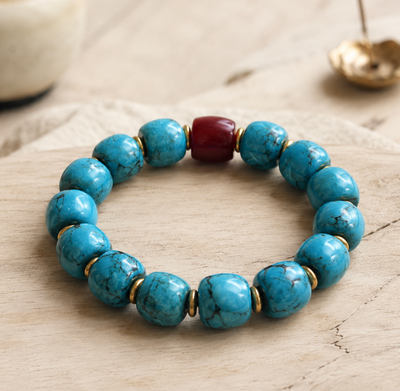
We have worked with her for just over two years. Every Hand-Woven piece in our collection — every bracelet, every woven cord — comes from her workshop and the women she trains. She described what she does once: weaving is not about earning money. It is about sorting out your days, one thread at a time.
The ledger full of symbols is probably a more honest record of this than anything we could have written down ourselves.
All Hand-Woven pieces in our collection are made by Sangmo and the women she trains in Nagqu. Browse the Hand-Woven collection →
→ Hand-Woven Tibetan Bracelets: What the Knotwork Means and How to Wear Them →