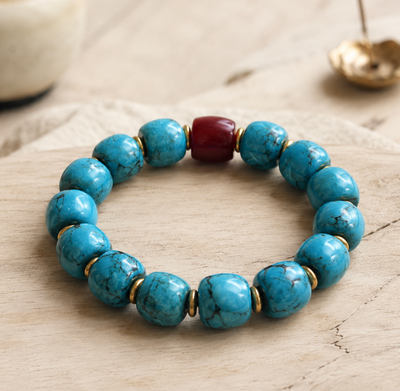
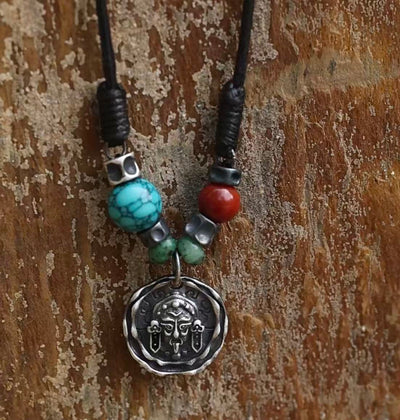
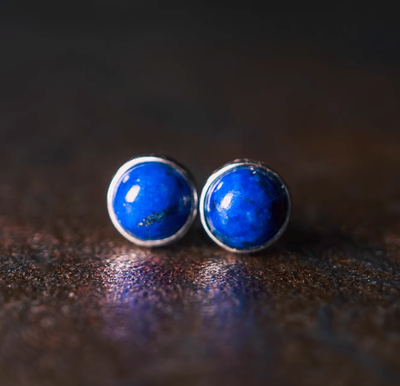
If you are especially drawn to cool steadiness and protective presence, the Turquoise collection offers pieces whose calm color and sacred character fit naturally within this Guardian theme.
Part of: Guardian · Sacred Protection Series ← Click to return to Hub
Some people leave a room and feel exactly the same as when they entered it.
Others leave feeling as if something has been taken from them.
Not in a dramatic way.
Not in a way that can always be explained.
Just a slight depletion. A strange agitation. A residue of someone else's anxiety, rudeness, competitiveness, resentment, or need.
This is especially common in modern life, where so much of our day is spent in high-contact environments. Offices. Airports. Meetings. Rideshares. Hotel lobbies. Open-plan workspaces. Family gatherings. Group chats. Places where many moods, ambitions, and unprocessed emotions are colliding at once.
You may not be “too sensitive.”
You may simply be under-protected.
At TibetanSerenity, Guardian is not only about warding off catastrophe. It is also about maintaining a clear boundary in environments that are subtly abrasive. Sometimes what exhausts us is not one major event. It is the accumulation of atmospheres that do not belong to us, yet somehow keep entering us.
What “Negative Energy Allergy” Really Means
The phrase sounds playful, but the experience is real.
You meet someone and your body tightens before your mind has an explanation.
You spend half a day in a tense office and return home carrying a mood that was not originally yours.
You travel for work, sleep in unfamiliar spaces, deal with crowds and negotiations, and begin to feel strangely porous—as if your attention has too many openings and not enough edges.
In spiritual language, people might call this “bad energy.” In psychological language, we might call it overstimulation, emotional contagion, or chronic boundary erosion.
The language matters less than the pattern.
Some environments puncture you.
Some personalities overrun you.
Some rooms ask too much of your nervous system.
When this happens often enough, you start living in low-grade self-defense without ever feeling truly defended. You grow tired, snappish, dull, hypervigilant, or detached. You are not broken. You are simply carrying too much that never belonged to you.
Boundaries Are Not Only Verbal
We often talk about boundaries as if they are purely conversational.
Say no.
Be direct.
Protect your time.
All of that matters. But there is another level of boundary that begins before speech.
It is the felt sense that your space is your space.
That your mind does not have to merge with the room.
That another person's urgency is not automatically your emergency.
That provocation does not deserve immediate entry into your bloodstream.
This kind of boundary is energetic in the oldest sense of the word. It concerns the quality of your presence. Some people carry a centeredness that quietly says: You may approach, but you may not invade.
This presence is not aggression. It is composure with edges.
In Tibetan visual culture, protective forms often combine beauty with firmness. They do not apologize for being beautiful, and they do not apologize for being strong. Guardian follows that lineage. A piece with gravity, coolness, and distinct form can serve as a tactile reminder that openness and defensibility are not opposites. You can remain kind without remaining permeable.
The Workplace, Travel, and the Social Jungle
Workplace life tests boundaries in very specific ways.
There is the colleague who always arrives carrying stress and leaves it on everyone else's desk.
There is the meeting where one person's insecurity becomes the room's weather.
There is the subtle politics of being watched, compared, interrupted, second-guessed, or emotionally managed.
Travel adds another layer.
Airports scatter attention.
Hotel rooms can feel impersonal.
Schedules become compressed.
Your body loses its familiar rhythms.
Your mind becomes more impressionable simply because you are tired.
In these states, boundary loss becomes easy. You answer things you should have ignored. You absorb tones you should have filtered. You become available to energies that should have remained outside the gate.
This is why protective practice matters most in ordinary high-friction settings. Not because every office is hostile or every airport is cursed, but because modern life repeatedly asks your nervous system to stay open in places that do not deserve full access to you.
How a Protective Object Helps
A protective object does not argue with the world on your behalf.
It does something more subtle and, often, more useful.
It interrupts unconscious merging.
You touch it in the middle of a difficult conversation and remember your own center.
You feel its coolness while traveling and remember that unfamiliar surroundings do not need to enter your core.
You notice its weight when a room becomes tense and remember that you are allowed to stay grounded instead of absorbing the room's turbulence.
This is why the feel of an object matters. Texture. Density. Temperature. Form. The hand can sometimes restore what language cannot. Before you can say, “I need a boundary,” your body may need a signal that a boundary exists.
Guardian pieces are meaningful in this way. They offer not spectacle, but resistance—a small physical reminder that you are not required to be psychically available to everyone, everywhere, all the time.
There is freedom in that.
Refusing What Does Not Belong to You
One of the most elegant forms of self-protection is not fighting harder, but refusing unnecessary entry.
You do not need to process every hostile glance.
You do not need to metabolize every manipulative mood.
You do not need to let every social current wash through your inner architecture.
This refusal can be soft.
It can be almost invisible.
A breath.
A touch.
A remembered phrase:
This is not mine.
This does not enter.
I return to myself.
That is a boundary too.
Over time, it changes your whole way of moving through the world. You become less easily punctured. Less likely to carry home what should have ended elsewhere. Less prone to confusing exposure with generosity.
You can still be loving. You can still be responsive. You can still be deeply human.
But you no longer have to be an open field for every passing storm.
For Those Who Move Through Noisy Places
If you work around intense personalities, travel often, enter crowded or emotionally charged spaces, or simply find yourself exhausted by too much contact with the world, Guardian may speak to you.
Not because you are fragile.
Because you deserve a cleaner threshold.
The social jungle rewards people who know how to remain intact.
Not hardened beyond feeling.
Not cold beyond connection.
Just clear enough to know where they end and the rest of the world begins.
🛡️ Guardian Series · For You
If you are looking for a protective companion for workdays, travel seasons, and high-contact environments, we invite you to explore the TibetanSerenity Guardian Collection.
These pieces are designed to support composure, reinforce inner boundaries, and help you stay present without becoming overly permeable to the moods and pressures around you.
👉 Explore TibetanSerenity Guardian Collection
You Might Also Like
- Peace Is Not a Given: How to Build an Invisible Shield Around Your Happiness
- Family Peace Insurance: A Protection That Travels Across Distance
Return to Guardian Hub · Read Pillar: The Silent Power of the Himalayas: A Philosophy of Sacred Protection