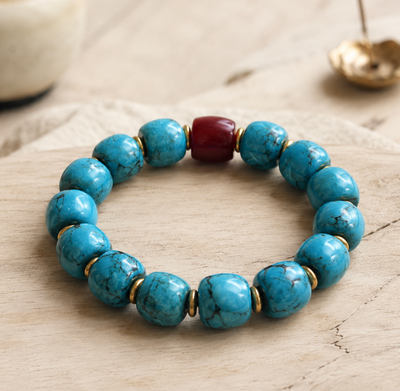
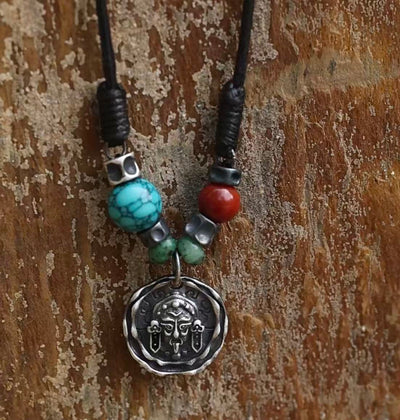
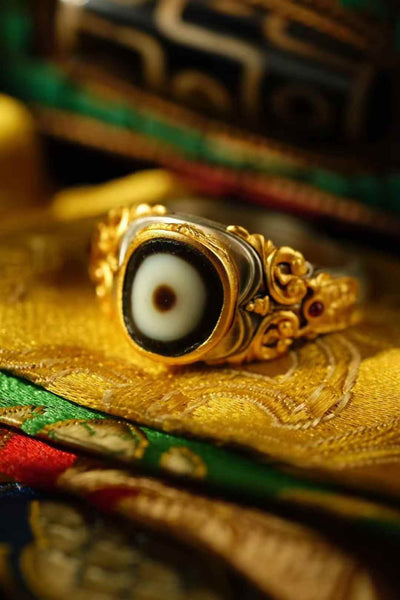
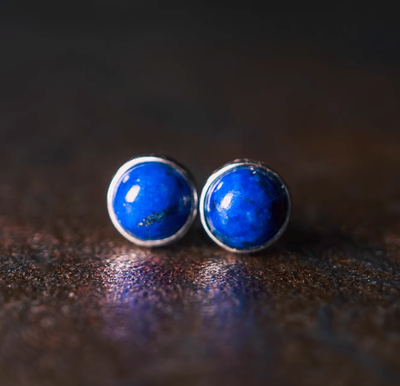
For a similar sense of small, repeatable daily anchoring, our bracelet collection offers easy-to-wear pieces that can stay close at hand throughout the rhythm of an ordinary workday.
Part of: Wellness · Healing Series ← Click to return to Hub
I know a woman who works at a major tech company.
Her desk is by the window, with a great view—she can see the traffic below and a patch of green in the distance. But she told me that in her first six months, she never once looked out.
"Every day was just: head down working, head up for meetings, head down replying to messages, head up to eat takeout. Open my eyes and there's a new requirement. Close my eyes and it's time for retrospective."
Last year, her checkup came back with mild anxiety and straightened cervical spine curvature. The doctor said, "You need to learn how to relax."
She said, "I don't know how."
Then she started doing one thing.
Every day after lunch, she puts her phone face-down on the desk, puts in her headphones, but listens to nothing. Then she reaches into her bag and pulls out one thing—a silver bead, strung on a simple leather cord.
She holds it in her hand and looks out the window.
For five minutes.
The first time she tried it, she said her mind wouldn't stop. First it was thinking about the afternoon meeting, then that message she hadn't replied to, then the PPT due tomorrow. She'd been holding the bead for three minutes before she realized she wasn't really holding it at all—she was just "sitting there thinking."
But she tried again the next day. And the next. And the next.
Slowly, those five minutes began to change.
She started to feel the temperature of the bead—cool when it first came out of her bag, warming up as she held it. She started to feel its weight—not big, not heavy, but definitely there in her hand. She started to feel the texture on its surface—those tiny carved lines, like footprints of time.
Sometimes, as she held it, unrelated things would drift into her mind. Her grandmother's courtyard when she was little. A boy she had a crush on in college. A sea she visited on a trip last year. None of these things had anything to do with work. But they would show up on their own during those five minutes.
She didn't shoo them away. She just let them stay for a while, then let them leave on their own.
When the fifth minute ended, she'd put the bead back in her bag, flip her phone over, and start the afternoon's work.
The strange thing, she said, was that those five minutes solved nothing—the requirements were still there, the messages were still there, the PPT was still there. But her afternoon was just... different.
What Can Five Minutes Do?
In this era, five minutes is nothing.
Gone in two short videos. Gone in a few replies. Gone in the time it takes to wait for a coffee.
But if you're willing to take five minutes each day—doing nothing "useful," just holding something and looking out the window—
Those five minutes might be the only time in your day that truly belongs to you.
Tibetans call this a "reliance object" —something that gives your heart a place to rest. For a traveler, it might be a bead carried close to the body. For a practitioner, it might be a mala. For that woman at the tech company, it's the window at noon and the silver bead in her palm.
At TibetanSerenity, we work with this understanding: that the right object, held at the right moment, can bring you back to yourself.
You're not solving problems. You're just reminding yourself: I'm still here. I'm still alive. I can still feel.
Why Do You Need Something to Hold?
You might ask: Why do I need to hold something? Can't I just sit there and stare into space?
You can. But for most modern people, "just sitting there staring into space" is incredibly hard. Your brain has been trained too well—the moment there's nothing to do, it automatically starts grabbing things to think about, problems to chew on, anxieties to feed.
That's when you need an anchor.
Something with warmth, with weight, that can be touched. It doesn't ask you to think—it asks you to feel. When you shift your attention from "the thoughts in my head" to "the sensation in my palm," your nervous system receives a signal: No need to fight. No need to flee. No need to solve anything. Just be here. Hold. Breathe.
This isn't mysticism. It's what psychology calls "grounding techniques."
Tibetans understood it a thousand years ago—they just crafted it into things you can wear.
You Could Try It Too
It doesn't have to be at noon. It doesn't have to be five minutes.
It could be in the morning, before you even get out of bed. It could be after work, sitting in your car for a few minutes. It could be at night, after the lights are off, in that small pocket of darkness.
Find something you'd be willing to hold every day. It doesn't need to be expensive. It doesn't need to mean anything to anyone else. As long as its touch feels good to you, its weight feels reassuring.
Then give it a little time each day. And give yourself a little time too.
The problems that aren't solved won't disappear in those few minutes. But in those few minutes, you'll remember: Besides all those problems, I'm still alive.
🌿 Wellness Series · For You
If you're looking for something small to hold for a few minutes each day, take a look at the TibetanSerenity Wellness Collection.
Each piece has a gentle touch, a balanced weight—not to solve your problems, but to remind you: you're still here, you're still alive, and you deserve five minutes a day that are just yours.
👉 Explore TibetanSerenity Healing Jewelry
You Might Also Like
- When the Body Cries Out, How Can the Heart Not Be Absent?
- To Those Tossing and Turning at Night: Sometimes Stopping the Pain Is Its Own Practice
Return to Wellness Hub · Read Pillar: The Sacred Protection of Tibetan Jewelry