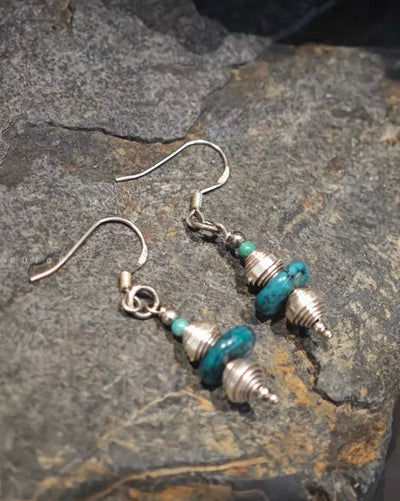
If this idea of nighttime grounding resonates with you, you may also explore the Amethyst collection, where calm color and quiet symbolism support moments of rest and emotional reset.
Part of: Wellness · Healing Series ← Click to return to Hub
It's 3 a.m., and you're awake again.
Your mind is like a tape recorder stuck on repeat, playing back that sentence from earlier today, that incident, that person's expression. You know this isn't helping. You tell yourself, “Stop thinking, go back to sleep.” But the more you suppress, the harder the thoughts fight back. By the time dawn creeps in, you finally drift off—only to wake up more exhausted than when you went to bed.
Psychology has a precise name for this state: rumination. It's what animals do when they regurgitate food to chew it again. Humans do it with events that have already happened. On the surface, it looks like you're trying to “understand” or “find the cause.” But in reality, each “chew” tears open the wound one more time.
At TibetanSerenity, we work with an old Tibetan idea: “clinging as a blade.” You think you're tending to a wound, but you're actually cutting it again and again with your thoughts.
We were raised to be strong, to tough it out, to find solutions. But no one told us that not every problem has a solution. Some harm has already been done. Some people have already left. Some things have already happened. At that point, continuing to “think it through” isn't strength—it's self-harm, a second wound.
It's like a physical injury: if you keep picking at the scab, it will never heal. Psychological wounds are the same. Every bout of rumination is just throwing salt on the cut.
So the task now isn't to “figure it out.” The task is to stop the inflammation.
What does stopping inflammation mean? It means giving yourself permission not to understand yet. It means admitting, “This really hurts, and I'm really sad.” It means shifting your attention from why did this happen to what do I need right now.
There are so many traps in life. When you fall into one, the first thing to do isn't to claw your way out—it's to stop digging.
But we love to keep digging.
A relationship has clearly rotted, yet we think, “Maybe if I endure a little longer, they'll change.” A job should have been quit long ago, yet we think, “Maybe if I wait a little longer, it'll get better.” A thought has been circling for three months, yet we think, “Maybe if I think a little longer, I'll finally understand.”
We've been taught to admire persistence and fear giving up. But some things, if you persist in them, become self-torture.
Tibetan Buddhism has a concept called “renunciation”—not giving up, but realizing something is draining you, and deciding you're done playing this game. Not because you've won. Because if you keep playing, you'll lose yourself.
We struggle to let go because a voice inside says, “If I give up now, won't all the suffering I've endured be wasted?”
This voice sounds noble, but it's actually the biggest trap. You've been sad about that thing for three months. You think that if you let it go now, those three months of sadness will have been for nothing. So you keep being sad—just to prove that your earlier sadness was justified.
Have you ever heard a more twisted logic? Using your present to bury your past.
There's a Tibetan saying: “Don't spend your whole life paying for one night's mistake.” That thing is over. That person is gone. That mistake has already been made. Every minute you spend now in rumination, self-blame, or resentment isn't solving anything—it's keeping a dead thing on life support.
Stopping the loss isn't betraying your past self. Stopping the loss is being fair to your present self.
If you're now caught in a loop—replaying something that's already over, exhausting yourself in a relationship you can't leave, trapped by a thought that only gets darker the more you think—
I want to tell you: You don't need to understand. You don't need to wait for the perfect moment. You don't need to prove you were right. You only need to do one thing: stop.
Stopping isn't surrender. Stopping is when you finally start protecting yourself.
When Tibetans travel far from home, they carry a small reliance object—not for good luck, but for those moments when they've taken a wrong turn, so they can touch it and remember: time to turn back.
You can give yourself such an object. Something you can always reach for—warm, solid, with a bit of weight. Next time you find yourself digging deeper into that hole, touch it and ask:
Am I going to keep digging?
Or can I stop now?
The answer—you've known it all along.
🌿 Wellness Series · For You
If you're looking for a tactile anchor to help you stop, take a look at the TibetanSerenity Wellness Collection. Each piece has a gentle touch and a balanced weight—not to give you answers, but to remind you: when it's time to stop, stop.
👉 Explore TibetanSerenity Healing Jewelry
You Might Also Like
- When the Body Cries Out, How Can the Heart Not Be Absent?
- The One Thing She Does at Her Desk Every Afternoon
Return to Wellness Hub · Read Pillar: The Sacred Protection of Tibetan Jewelry