Two things trip people up when buying tiger eye: telling natural stone from dyed glass, and choosing between the golden-brown, red, and blue (hawk's eye) versions. This covers both, plus how to pair it and keep it.
Spotting Dyed or Glass Tiger Eye
What you're paying for in tiger eye is the moving band of light across the surface. Turn your wrist and a bright line slides over the stone. That's chatoyancy, caused by light bouncing off the parallel fibrous structure inside the quartz. On real tiger eye the band looks alive and slightly irregular, and its edges soften as the angle shifts. Glass imitations overshoot it: one dead-straight line of light pinned to the center, with color too vivid to read as natural.
Color tells you the rest. Natural tiger eye moves from gold to deep brown across a single bead and varies from bead to bead. Dyed material sits too even, the color floating on the surface, every bead nearly identical.
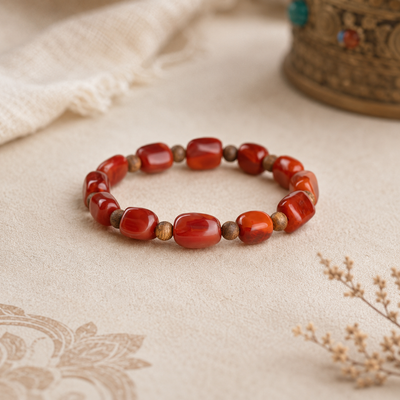
One thing that isn't a scam but is worth knowing: most red tiger eye is heat-treated. The large majority on the market is golden tiger eye heated until it turns red, which is standard industry practice rather than fakery. Genuinely untreated red is uncommon and priced higher, so the only real problem is a seller charging heat-treated red as if it were rare natural stone.
Price is the last signal. Anything going for a dollar or two a bead is almost certainly dyed low-grade material or glass, with none of that living light.
The Colors, and Who Each One Suits
Golden-brown is the classic, and the one I'd steer a first-time buyer toward. It pairs with silver, brass, and dark woods, works with whatever you're wearing, and doesn't get old.
Red tiger eye, usually heat-treated, runs warmer and louder, and suits you if you want presence or have a warm skin tone. Blue hawk's eye is the cool grey-blue cousin with the same moving light but a quieter feel, a good second piece once you already own a golden one. There's also a gold-and-blue mix that sellers call "galaxy" or multicolor tiger eye. It photographs unreliably and is the fussiest to match, so try to see that one in person before buying.
Bead Size and Pairing
Size sets the whole feel. 6 to 8mm reads low-key, stacks well, and sits comfortably on a smaller wrist. 10 to 12mm has real presence and tends to be worn on its own, more often by men. If you're unsure, 8 to 10mm is the safe middle for anyone.
Being a warm stone, tiger eye goes naturally with silver, brass, and ebony. You'll see a lot of bracelets that string it with black obsidian, and that is a deliberate pairing: the flat black of obsidian grounds the gold of the tiger eye, light against dark. In many Himalayan-style pieces the two are read as one steadying and one protective, though that reading varies by maker.
Tiger Eye in Himalayan Wear
In many Himalayan wearing customs, tiger eye is grouped with the steadying stones and worn by people who want focus, or a steadier head when making decisions. How much you read into that is your call, and the specific associations vary by region and person. Either way it is an easy stone to live with: hard-wearing, simple to match, and fine for everyday.
Caring for Tiger Eye
Low maintenance. Tiger eye is quartz, around 7 on the Mohs scale, so everyday knocks rarely leave a mark. What it doesn't like is chemicals and water. Perfume, lotion, and cleaning products dull the surface light, and you shouldn't keep it on for long soaks like showers, swimming, or hot springs. Wipe it with a soft cloth now and then. The surface grows warmer and glossier with wear, which is normal rather than damage.
Not sure which stone to start with? See how to choose stones and crystals by intention.
 Shop
Shop
 Shop
Shop
 Shop
Shop
 Shop
Shop
 Shop
Shop
 Shop
Shop
No. At a dollar or two a bead you are usually getting dyed glass or low-grade material with no real chatoyancy, and it can lose color with wear. Pay a little more for stone that shows a clear, moving band of light.
Not fake, but the large majority of red tiger eye is golden tiger eye heated until it turns red, which is standard practice in the trade. Untreated natural red exists but is uncommon and costs more.
Take it off for showers and swimming. Brief contact with water is fine; long soaks and contact with chemicals like soap and perfume are what to avoid.