Tibetan stone jewelry is not organized around clarity or sparkle. The stones that appear most often in this tradition — turquoise, nanhong, agate — are chosen for color depth, grain, and cultural resonance. If you are used to shopping for jewelry by cut or carat, the priorities are different here.
This guide covers the three main stones in TibetanSerenity's Tibetan Stones line, what each one looks like and feels like, what they are associated with in Tibetan and Himalayan craft contexts, and how to decide which one is right for what you are looking for.
What Makes Tibetan Stone Jewelry Different
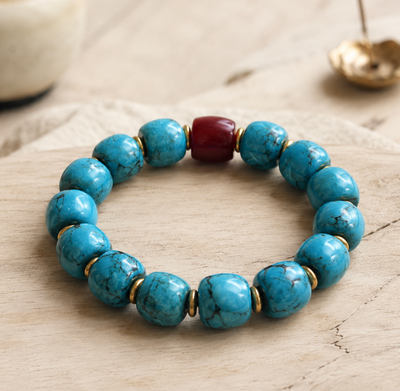
Most contemporary jewelry markets prioritize uniformity — stones graded and sorted so that each piece in a batch looks identical. Tibetan stone jewelry works from the opposite premise. The variation in color across a strand of turquoise beads, the slight differences in grain between two agate pieces, the tonal range within a nanhong cabochon — these are the point, not a quality problem to be corrected.
The result is jewelry where no two pieces are exactly alike, and where the material itself carries the visual interest rather than the setting or the cut. For people who find conventional fine jewelry too uniform, too polished, or too decorative, this is often a significant shift in what jewelry can feel like.
Turquoise
Turquoise is the most recognizable stone in the Tibetan jewelry tradition. Its blue-green color — ranging from deep sky blue to blue-grey to blue-green depending on origin and mineral composition — has made it one of the most used stones in Himalayan adornment for centuries. In many Tibetan craft contexts, turquoise is associated with protection and auspiciousness, though the specific meanings vary considerably by region, lineage, and maker.
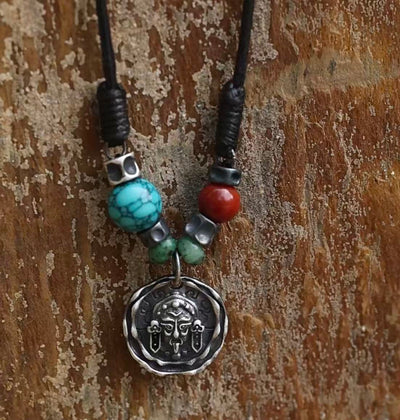
In practical jewelry terms, turquoise is visually strong. It holds its own in simple settings and does not need elaborate metalwork to carry a piece. A single turquoise bead on a woven cord, or a turquoise inlay in a silver setting, reads clearly. The stone also layers well with silver — the cool tones of both materials are naturally compatible.
Who it suits: people who want a piece with clear visual presence, who are drawn to blue-green tones, or who want jewelry with a connection to the Himalayan material tradition specifically rather than crystal practice in general.

Nanhong
Nanhong is a variety of agate found primarily in Yunnan province, China. The name translates roughly as "southern red," which describes its defining characteristic: a deep, warm red tone that ranges from brick and vermilion to near-orange, often with subtle internal banding or clouding that gives each stone its own pattern. High-grade nanhong has a visual depth that most red stones do not — the color appears to come from within the stone rather than sitting on the surface.
It is not a widely known material in Western jewelry markets, which means pieces featuring it tend to stand out. Collectors and people who follow Chinese jewelry traditions often prize nanhong specifically, but for most buyers the appeal is more immediate: the color is warm and rich in a way that few natural materials match.
Who it suits: people drawn to warm, earthy tones rather than cool blues or pale pastels. Works well as a statement piece or a gift for someone who appreciates unusual materials. Particularly well-suited for gifting when you want something with visual distinctiveness.
Agate
Agate is the most versatile of the three. It comes in a wide range of colors — warm amber, grey-brown, banded black and white, deep red — and the banding patterns visible in many agate stones give each piece a natural visual complexity that works across aesthetics. It is not as culturally specific as turquoise or as rare as nanhong, which makes it a more accessible starting point for people new to stone jewelry.
In terms of wear, agate is durable and relatively low-maintenance compared to more porous stones. It does not require the same level of care as turquoise, which makes it a practical choice for daily wear. The range of tones also means it pairs more easily with other materials — earthy agate tones layer naturally with wood, silver, and woven cord.
Who it suits: people buying their first Tibetan stone piece, those who prefer understated pieces over statement ones, and anyone layering across multiple materials.

How to Choose Between the Three
Start with color. Turquoise is blue-green and cool. Nanhong is deep red and warm. Agate spans a wide range but tends toward earthy neutrals and warm tones. If you have a strong color preference, that usually settles the question.
If color is not the deciding factor, think about context. Turquoise reads as culturally specific and visually strong — it works best when that specificity is the point. Nanhong is the choice when you want something unusual and warm-toned. Agate is the choice when you want something wearable every day without thinking about it.
For gifts: nanhong for someone who collects or appreciates unusual materials. Turquoise for someone with a connection to Tibetan or Southwestern aesthetics. Agate when you want something reliable that will work with their existing wardrobe.
Turquoise in Tibetan Jewelry: Meaning, Symbolism, and How to Choose →
What Is Nanhong? Color, Meaning, and Why Collectors Love It →
Agate in Tibetan Jewelry: Meaning, Texture, and Everyday Wear →
Tiger Eye: Telling Real from Dyed, and Choosing a Color →
Obsidian: Real vs Glass, the Types, and How to Choose →
Jade: Jadeite vs Hetian, Treatments, and How to Choose →
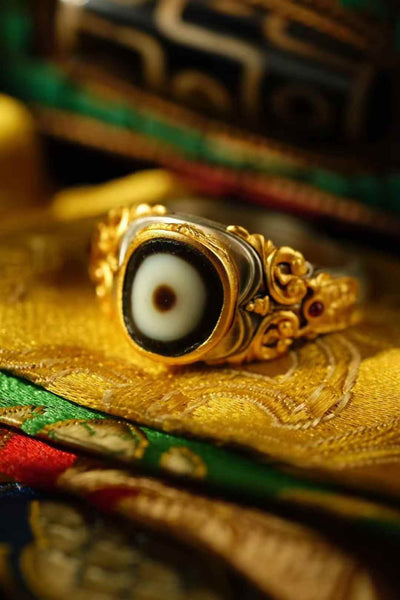
Dzi Beads: The Eyes, Old vs New, and How to Choose →
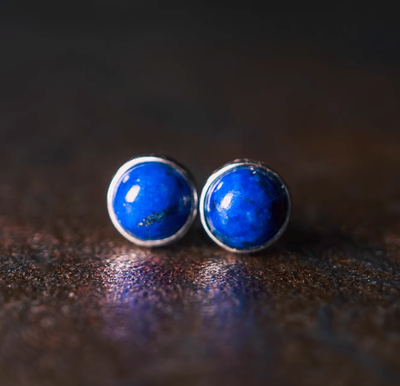
Lapis Lazuli: Reading Quality, Spotting Fakes, and How to Choose →
Turquoise is porous and sensitive to moisture, oils, and chemicals — remove it before showering, swimming, or applying lotion. Nanhong and most agate varieties are harder and less porous, making them more resilient for daily wear. For all stone pieces, avoid prolonged direct sunlight, which can affect color in some stones over time. Wipe clean with a dry or slightly damp cloth rather than soaking.
Yes. The turquoise, nanhong, and agate pieces use natural stones. Natural stones will have variations in color, surface, and pattern between pieces — this is expected and part of what makes each piece distinct. If you see something that looks perfectly uniform in a stone piece, it is likely dyed or synthetic.