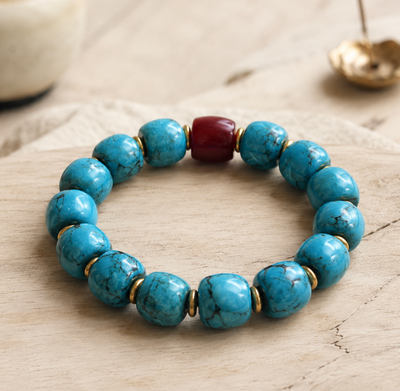
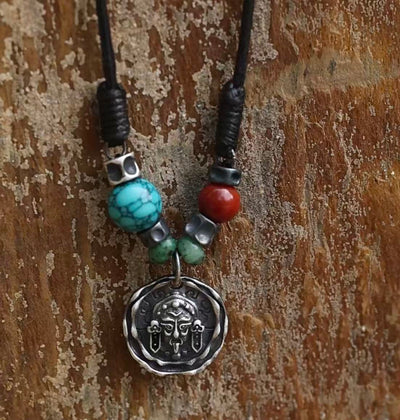
Turquoise ranges from deep sky blue to blue-green to grey-green, and the variation within a single piece — the lighter patches, the darker matrix lines, the subtle shifts in tone across a strand of beads — is what gives it visual life. A piece of turquoise that looks perfectly uniform is likely dyed or synthetic. Natural turquoise is never perfectly uniform.
This guide covers what turquoise is in the context of Tibetan jewelry, what it is associated with, how to evaluate quality, and how to decide whether it is the right stone for what you are looking for.
Turquoise in the Tibetan Tradition
Turquoise has been used in Tibetan and Himalayan adornment for centuries. In many Tibetan craft contexts, it is associated with protection, auspiciousness, and safe travel — though the specific meanings vary considerably by region, lineage, and maker. It appears in jewelry worn by both men and women, in sacred objects, and in ceremonial contexts across the broader Himalayan cultural area.
What makes turquoise distinctive in this tradition is that its value is not primarily about rarity or precious metal content. It is about the stone's visual and symbolic qualities — the specific color, the surface character, the way it has been used and understood across generations of makers and wearers. A piece of turquoise that has been shaped and worn carries associations that go beyond what it looks like.
Reading Turquoise Quality
Natural, untreated turquoise is the benchmark, and also the most expensive. It has been neither stabilized with resin nor dyed to enhance color. The color is uneven in the way natural minerals are uneven. The matrix lines — the darker veins of host rock running through the stone — are present and natural.
Stabilized turquoise has been treated with resin to harden the stone and make it more suitable for jewelry use. This is very common and not inherently problematic — it produces a more durable piece at a lower price point. The color is more uniform than natural turquoise but still shows natural variation.
Dyed turquoise has been color-treated to produce a more vivid or uniform blue. The color is noticeably saturated and consistent in a way that natural material never is. It is significantly cheaper than stabilized or natural turquoise.
For everyday wear purposes, stabilized turquoise is a practical and honest choice. For buyers who want natural material specifically, ask before purchasing — reputable sellers will tell you clearly what you are buying.
How to Choose
Start with the color. Turquoise ranges across a wide spectrum — some people respond strongly to the deeper blue end, others prefer the blue-green or grey-green tones. There is no universally correct color; the right one is the one that reads well with how you dress and what you already own.
Consider the matrix. High matrix (lots of darker veining) gives a piece more visual complexity and a more organic character. Low matrix (cleaner, more solid color) reads as cleaner and more minimal. Neither is better — they create different visual effects.
Think about the setting. Turquoise pairs naturally with silver — the cool tones work together. In Tibetan-style pieces, an oxidized silver setting with a turquoise inlay or bead creates a visual combination that has been refined over generations of makers. Turquoise set in gold-toned metals is less traditional and requires more care to work well.

Caring for Turquoise
Turquoise is more sensitive than most other stones used in jewelry. It is porous, which means it absorbs liquids — including water, sweat, and skin oils — and can change color or surface texture over time with repeated exposure. Remove turquoise jewelry before showering, swimming, or exercising. Avoid applying lotions or perfume while wearing it. Store it away from other jewelry that might scratch the relatively soft surface.
Over time, natural turquoise often develops a patina from skin contact — a slight warming or deepening of tone. Many wearers consider this desirable, a visible record of the piece being worn. Stabilized turquoise is more resistant to this kind of change.
Natural and stabilized turquoise both show color variation across the surface — no two areas look exactly the same. Dyed or synthetic turquoise looks too uniform. Matrix lines in natural turquoise are irregular and organic; in imitation materials they may be painted on and look too regular. Price is also a signal: genuine natural turquoise at very low prices is a red flag. When in doubt, ask the seller directly about the material.
Natural turquoise can change color with prolonged exposure to moisture, oils, and light. Many pieces gradually warm slightly in tone with regular wear — this is a natural patina, not damage. Stabilized turquoise is more resistant to color change. Dyed turquoise may fade with sun exposure. Keep all turquoise away from chemicals and prolonged moisture to slow any changes.