Tenzin's workshop is small. One grinding machine, one basin of water, and a row of unfinished blanks on the windowsill, most of them agate. He doesn't talk much once he sits down, and his hands don't stop while you talk. Ask him a question and he'll hum first, think for a moment, then give you a short answer. Ask how long one dzi bead takes and he'll say it depends on the stone. A few days, if it goes well. If it doesn't, the bead is simply gone.
He is not Tibetan by birth. He learned stone grinding in his home province and first went to Lhasa at twenty, following a batch of orders. The plan was to finish the work and leave. Instead, the work kept him. Everything he made there had someone waiting to use it: malas meant for daily recitation, gau boxes worn against the chest, dzi beads that would be worn for a lifetime. He never puts it into big words. He just says he liked making things that were part of how people lived. Somewhere in those first years, the people around him began calling him Tenzin, and the name stuck. He stayed twenty years, making Tibetan handicrafts in Lhasa.
Which brings us to how he picks stone.
Agate looks tough but is a picky material. For dzi work the texture needs to be fine and even, and the color banding should follow the shape of the bead, so the finished pattern sits naturally. Rough stone has to be looked at wet. That is standard practice in the trade, not a secret: dry rough hides things, and only water brings out the hairline cracks and the cloudy patches. Tenzin is stricter with bead stone than with anything else, for a practical reason. On a pendant, you can cut around a flaw. On a bead there is nowhere to hide, because a bead gets seen from every side in the hand. So he turns over a pile of rough for half a day and puts most of it back, and he would rather come home empty-handed than settle. He has paid for the lesson: a hidden crack inside the stone, invisible from the surface, found only after cutting, with days of work already lost. The way he puts it, good work cannot fix bad stone.

Once the stone is chosen, he cuts the blank and rounds it on the wheel. Whether a bead is truly round is judged by eye and by hand; the caliper only confirms at the end. Rounding looks simple and is the hardest thing to teach. Grind too much and there is no taking it back. Then the bead is drilled from both ends, and the two holes have to meet straight, or the bead will never sit right on a cord or in a setting.
The eye pattern is the stage that ruins beads. The lines go on one stroke at a time. The circles have to be round, the spacing even, and one slip of the hand downgrades the bead. After the pattern is set, the bead goes back to the wheel and is polished again and again, until pattern and stone feel like one surface, flat under a fingertip, nothing catching. A properly finished bead glows from the inside. An under-polished one can still look shiny, but the shine floats on top of the stone instead of coming out of it. Photographs don't always show the difference. Hands do.
The final polish runs through several wheels, coarse to fine, slower at every stage. The last passes are mostly water and time. His acceptance test has not changed in years: roll the bead once across the palm, hold it up to daylight, wet it and look again. If any of the three feels wrong, it goes back to the wheel.
The ruined blanks and downgraded beads don't get thrown out. They collect in a jar on the windowsill. A reminder, he says, to keep his hands slow.
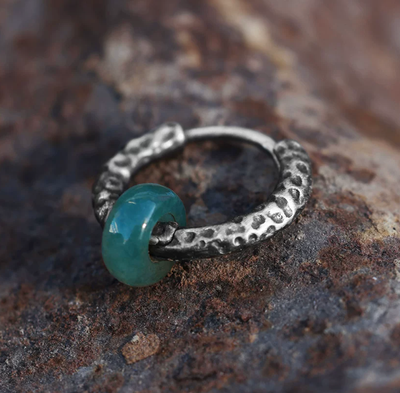
When a bead leaves his table, the next stop is the silversmith's bench, where it is set into a ring. The silver is another master's work; that story belongs to Tsering. Tenzin's job ends at one point only: the bead leaves him as good as he can make it.

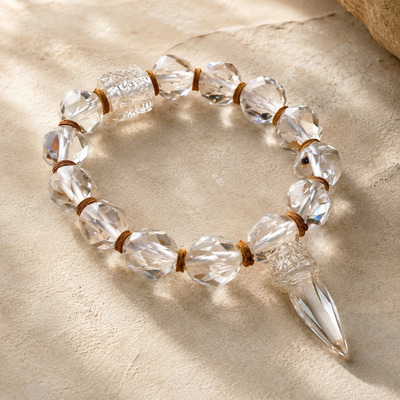
Besides dzi, the carved crystal pieces in the store are his as well, the vajra earrings and the Manjushri sword pendant. And for the bracelets that combine several stones, incoming bead lots pass through his hands first: wetted, checked one by one, the cracked and off-color pulled out, failed lots sent back whole.
In the years we have worked with him, the person who rejects the most pieces is Tenzin himself. Anything he doesn't consider fully finished does not go up for sale.
Frequently Asked Questions
Which rings use Tenzin's dzi beads?
The five dzi rings in our latest collection: Kui Dragon Dzi Ring, Six-Syllable Mantra Dzi Ring, Vajra Claw Dzi Ring, Zachiram Gilt Dzi Ring, Zachiram Silver Dzi Ring. Each bead was ground and polished by hand in his workshop before being set in sterling silver.
Why do pieces of the same design differ slightly?
No two hand-polished stones come out identical. The pattern lines, the polish, and the stone's own banding all vary a little. That is a feature of handwork, not a defect.