Dzi beads come with more myth and more fakery than almost any other bead, so the questions worth answering before buying are simple: what a dzi actually is, whether you need an "old" one, and how to read the eyes. Here is the practical version.
What a Dzi Bead Actually Is
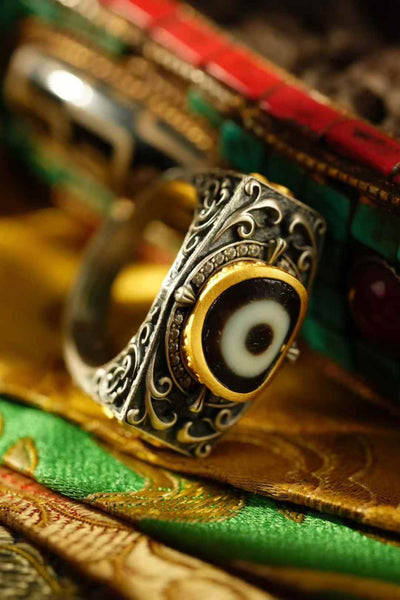
A dzi (གཟི, pronounced "zee") is an agate bead patterned with circular shapes called eyes, made by an old etching technique that draws light and dark lines into the stone. They have been worn across Tibet for a very long time as protective beads, and they carry more legend than any other bead in the Himalayan tradition, with origin stories ranging from beads that fell from the sky to ones left by retreating glaciers. None of that is meant literally; it is a way of saying nobody fully knows their origin.
Old vs New: Where the Money Goes
This is the part that matters most. Genuine antique dzi are rare and can sell for the price of a car, and the market is flooded with fakes at every level, from convincing aged agate to printed glass. Telling a real antique dzi from a good fake takes real expertise, and even collectors get burned. For almost everyone, the sensible choice is a new etched-agate dzi, bought openly as a new piece for its look and its meaning. Buy an "antique" dzi only from a seller who can authenticate it, and assume cheap "old" dzi is new.
Reading the Eyes
Dzi are described by the number of eyes, usually from one up to nine and beyond, and each count is read symbolically. In many traditions a single eye is linked to clarity, three eyes to fortune, nine to completeness, and so on, with protective dzi among the most sought. The specific readings vary a lot by region and lineage, so it is fair to pick the one whose meaning or look speaks to you rather than treating any chart as fixed.
How to Wear It
A dzi is usually the centerpiece, strung on a cord or set among plainer beads like agate, bone, or wood so it stays the focus. One good dzi on a simple strand reads better than several competing for attention. They suit men and women equally and work as an everyday piece rather than something saved for occasions.
Dzi in Tibetan Tradition
Across Tibetan wearing customs the dzi is treated above all as a protective, auspicious bead, often passed down in families. As with most of these meanings the details shift by region and teacher, so take the symbolism as living tradition rather than a rulebook.
Caring for Dzi
Easy. Dzi is etched agate, a hard quartz that holds up to daily wear. Keep it from hard knocks, since a sharp drop on stone can still chip any agate, and away from harsh chemicals. A soft cloth is all it needs, and the surface usually warms to a soft sheen over years of wear.
Not sure where dzi fits among the stones? Start with stones and crystals in Tibetan jewelry.


Genuine antique dzi are rare and extremely expensive, and the market is full of fakes at every price. Unless you are an experienced collector buying with authentication, you are usually better off with a clearly described new etched-agate dzi bought for the look and meaning, not as an investment.
The number of circular 'eyes' is read symbolically, with different counts linked to protection, fortune, or clarity. The specific meanings vary widely by region and teacher, so treat them as tradition rather than fixed fact.
Dzi is etched agate, a hard quartz, so it stands up to daily wear. Keep it from hard knocks and harsh chemicals, and wipe it with a soft cloth. The surface often takes on a soft sheen with long wear.