The most common hesitation about Tibetan silver jewelry is not about the jewelry itself — it is about the wearing.
Will it look too heavy? Too spiritual? Too unusual for a Tuesday morning?
These are reasonable concerns. Tibetan silver is visually distinctive. Its aged texture and symbolic surface set it apart from the minimalist fine jewelry that dominates most contemporary dressing. But this distinctiveness is also its strength — and learning to work with it, rather than around it, opens up a way of dressing that very few people have fully explored.
This guide is about that: how to wear Tibetan silver jewelry in everyday life, from a single statement piece to a fully layered wrist.
Start with One Piece
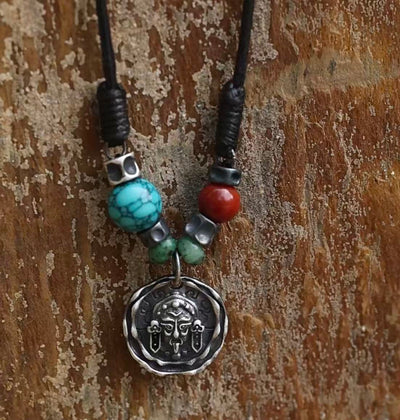
The single-piece approach is the most immediate and the most underrated. One Tibetan silver pendant on a plain cord or thin chain. One cuff on an otherwise bare wrist. One ring on a hand with nothing else.
In these configurations, the piece does not compete — it arrives. The aged texture and symbolic surface read clearly because nothing around them demands equal attention. This is particularly effective with plain, solid-color clothing: a white linen shirt, a dark knit sweater, a simple black dress. The simplicity of the outfit becomes a backdrop that lets a single piece speak at full volume.
For those new to Tibetan silver, starting with one piece is also practical: it lets you understand how the aesthetic actually integrates with the clothes you already own before committing to a more layered approach.
Layering: How to Build Without Overwhelming
Layering Tibetan silver works best when there is variation in type — not just adding more of the same. Consider a pendant necklace alongside a cuff bracelet: one at the neckline, one at the wrist, nothing between. The eye moves naturally between the two without being overwhelmed by density.
When layering necklaces, vary the length. A shorter pendant at the collarbone with a longer one below creates depth without crowding. Two pendants at exactly the same length compete rather than complement.
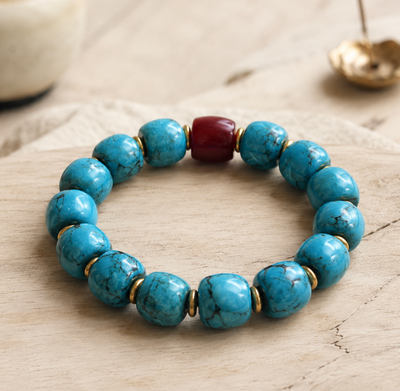
With bracelets, the most interesting stacks combine Tibetan silver with other materials. A silver cuff or beaded bracelet alongside a wooden bead bracelet from the Sacred Wood line, or a hand-knotted cord from Hand-Woven, creates textural contrast that makes each piece more visible. The warmth of wood against the cool depth of aged silver. The softness of woven cord against the solidity of metal. These combinations are more interesting than silver alone.
The general rule: combine textures freely, but respect density. Leave space. Not every finger, not every layer of the neckline, not every inch of the wrist.
Women's Styling
Tibetan silver sits comfortably across a wide range of women's aesthetics — from dressed-down everyday to quietly elevated.
Casual everyday: A pendant necklace over a plain tee or loose linen shirt. A stacked wrist mixing a silver cuff with one or two wooden bead bracelets. Minimal effort, significant presence.
Work settings: A single, understated piece — a thin silver ring with engraved detail, or a small pendant pendant that sits at the collarbone — adds depth without introducing distraction. The aged texture reads as considered rather than casual.
Evening: A longer pendant with a guardian or lotus motif over a plain dark dress. The contrast between the warm matte silver and dark fabric creates a strong, quiet impact that heavier or shinier jewelry often cannot match.
Men's Styling
Tibetan silver is exceptionally well-suited for men's jewelry. The aged, matte finish avoids the flashiness that makes many men uncomfortable with jewelry. The symbolic weight gives a piece meaning without requiring explanation. And the craft tradition it comes from is one where men have always been the primary wearers.
Bracelets: A single wide cuff or a beaded bracelet with silver accents sits naturally on the wrist. Combine with a wooden bead bracelet or woven cord for a layered wrist that reads as intentional rather than excessive.
Pendants: A Dorje, Om, or guardian figure pendant on a leather cord or plain silver chain. Worn inside or outside the shirt depending on context — inside for professional settings, outside when the piece is the point.
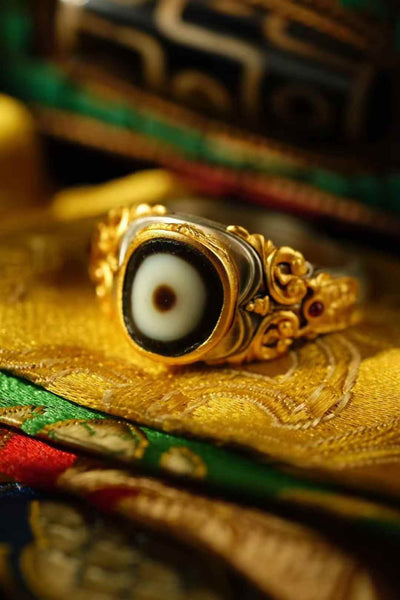
Rings: A wide band with engraved surface detail. In the Tibetan silver tradition, rings tend toward statement rather than delicate — a single ring worn on its own makes a stronger impression than several thin ones combined.
Gender-Neutral Approaches
Many of the most versatile Tibetan silver pieces occupy a genuinely gender-neutral space. Cuffs, cord bracelets, and pendant necklaces with geometric or symbolic motifs suit any wearer. The aesthetic — understated, aged, meaningful — is not gendered. It is simply human.
For mixed-gender gift-giving, a piece featuring the endless knot or the lotus tends to read as neutral and meaningful without being specifically coded in either direction.
Consider pairing with: Sacred Wood bracelets · Hand-Woven cords
← Back to Tibetan Silver: What It Is and How to Wear It · Tibetan Craft Overview
Frequently Asked Questions
How many pieces is too many when wearing Tibetan silver?
Does Tibetan silver work with formal or professional clothing?
Can Tibetan silver be mixed with gold-toned jewelry?
What clothing colors and styles work best with Tibetan silver?
For cross-material layering ideas — silver with wood or woven: Silver, Wood, and Weaving: How to Layer Tibetan Craft for Everyday Wear →