Some materials announce themselves.
Sacred Wood does the opposite. It asks nothing. It does not shine. It does not catch attention. It settles against the skin with a warmth that is difficult to describe — something between weight and texture, between presence and quiet.
This is what makes Sacred Wood jewelry different from almost everything else in the jewelry world. Its value is not visual. It is tactile. It is experiential. And for the people it suits — those who meditate, who move slowly through their days, who prefer substance over spectacle — it is irreplaceable.
What Sacred Wood Is
Sacred Wood is a category of natural materials used in Tibetan and Buddhist jewelry traditions for centuries. The most significant woods include agarwood (also called oud or chen xiang), sandalwood, and rosewood, and bodhi seed — the seed of the Ficus religiosa tree, under which the Buddha is said to have achieved enlightenment.
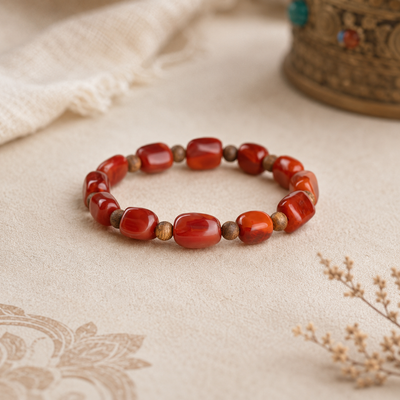
Each material has its own character. Agarwood is dense, resinous, and dark — among the most prized materials in Eastern spiritual practice, valued for both its rarity and its deep, grounding scent. Sandalwood is paler and lighter, with a clean, mild fragrance associated with clarity and calm. Rosewood is warm-toned and smooth, with a visible natural grain that makes each bead individually distinct.
What unites them is a shared quality: naturalness. These materials are not uniform. No two beads are identical. The grain runs differently, the color varies slightly, the weight shifts from piece to piece. This is not inconsistency — it is evidence of origin. Sacred Wood jewelry carries the mark of the living thing it came from.
Why Wear Wood Instead of Metal or Stone
People who are drawn to Sacred Wood jewelry are usually responding to something specific: a desire for grounding over glamour.
Metal jewelry — even aged, matte metal — has a hardness to it. Stone has density. Both of these qualities can be exactly right in certain moments and certain moods. But wood offers something neither metal nor stone can: warmth.
Pick up a wooden bead bracelet. It is immediately warmer to the touch than silver or turquoise. It is lighter. The surface has a subtle give — not soft exactly, but not cold either. When you roll a bead between your fingers, the sensation is grounding in a way that is almost reflexive, the way handling smooth natural objects has always been.
This tactile quality is not accidental in the Sacred Wood tradition. Many wooden pieces — particularly malas and prayer bead bracelets — are designed to be handled as well as worn. The texture is part of the practice.
→ Why Sacred Wood Feels Different: a closer look at texture, warmth, and the grounding effect.
Sacred Wood in Daily Life
Sacred Wood jewelry belongs in unhurried mornings. It belongs at a desk, in a studio, on a commute where you have decided not to look at your phone. It belongs in the hand during the minutes before sleep, and in the moment of sitting down to begin something that requires full attention.
It is not ceremony jewelry. It does not require an occasion. Its value is in the continuity of presence it offers — the steady warmth of something natural against the skin, throughout an ordinary day.
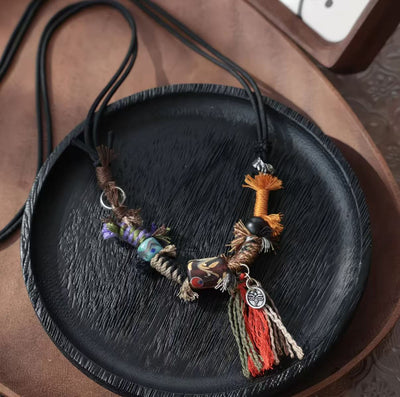
For meditation practitioners, Sacred Wood is a natural companion. Wooden beads are traditionally used as counting tools during mantra repetition and breathwork. For a deeper look at mala practice, see our guide to Bodhi Seed Malas. The texture provides a sensory anchor that keeps the mind from drifting without requiring effort. Many practitioners report that the simple act of moving beads through the fingers is itself settling.
But Sacred Wood does not require meditation practice to be meaningful. Anyone who wants a piece of jewelry that feels grounded, natural, and unhurried will find something in this line.
→ How to care for Sacred Wood jewelry: keeping your piece nourished and beautiful over the long term.
Sacred Wood as a Gift
Among the three Tibetan Craft lines, Sacred Wood is one of the most naturally giftable. It is warm without being sentimental. It is meaningful without being heavy. It communicates care without requiring explanation.
A wooden bracelet makes a strong gift for someone going through a period of stress or change — the grounding quality of the material is not metaphorical. It works as a mindfulness gift, a travel gift, a "thinking of you" gift, or a gift for someone who meditates or practices yoga.
It is also a forgiving gift in terms of sizing. Most Sacred Wood bracelets are worn loosely, and bead bracelets have natural flex. If you are unsure of someone's wrist size, a wooden bracelet is among the safest jewelry choices.
→ Not sure which wood to choose? Agarwood, Sandalwood, and Rosewood: a comparison guide.
In this series: Why It Feels Different · Wood Types Compared · Care Guide
Related reading: Bodhi Seed Mala Guide · Tibetan Silver Jewelry · Hand-Woven Jewelry
Or return to the full guide: Tibetan Craft: The Complete Guide
Frequently Asked Questions
How do I care for a wooden bead bracelet to keep it from cracking?
Does Sacred Wood jewelry have a scent?
Is Sacred Wood jewelry suitable for someone who has never meditated?
What is the difference between agarwood and sandalwood?
Want to layer sacred wood with silver or woven jewelry? Read: Silver, Wood, and Weaving: How to Layer Tibetan Craft for Everyday Wear →