There is a kind of jewelry that does not ask to be noticed.
It does not catch the light from across the room. It does not announce itself. It settles quietly against the skin — a piece of aged silver, a strand of warm wooden beads, a hand-knotted cord — and over time, it becomes inseparable from the person wearing it.
This is what Tibetan Craft is about.
At TibetanSerenity, Tibetan Craft is the name we give to three distinct material traditions that share a common philosophy: that what touches your body every day should be made with intention, shaped by hand, and connected to something larger than decoration.
These three traditions are Tibetan Silver, Sacred Wood, and Hand-Woven Jewelry. Each has its own character, its own texture, and its own place in a life lived with awareness. Together, they form the heart of what we make.
The Philosophy Behind Tibetan Craft
Tibetan artisans have long understood something that modern design is only beginning to rediscover: the objects we keep close to our bodies carry meaning. The weight of a silver pendant. The smooth warmth of a bodhi seed bracelet rolled between the fingers. The soft give of a hand-knotted cord against the wrist.
These sensations are not accidental. They are the result of choices — choices about material, about technique, about what a piece of jewelry is actually for.
In the Tibetan craft tradition, jewelry is not merely ornamental. It is a form of intention made wearable. A silver amulet carries a symbol chosen for its meaning. A mala of 108 beads is designed for counting breath and mantra. A woven cord bracelet is knotted with care, each loop a small act of making.
This is the philosophy that unites all three lines of Tibetan Craft at TibetanSerenity. Not the pursuit of flash. Not trend-chasing. But the quiet conviction that what you wear every day should mean something.
Tibetan Silver: Quiet Strength, Aged Beauty
Tibetan silver jewelry is immediately recognizable by what it is not: it is not mirror-bright, not pristine, not uniform. Its surface carries a matte, aged quality — the texture of something made by hand and worn through time.
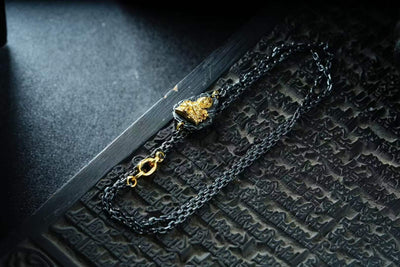
This quality is intentional. Tibetan silversmiths work with oxidized finishes and hand-hammered surfaces that catch light softly rather than reflecting it sharply. The result is jewelry that looks like it has a history, even when new.
The symbols found in Tibetan silver — the endless knot, the lotus, the Vajra, the Dorje — are not decorative motifs chosen for visual appeal alone. Each carries a meaning rooted in Tibetan Buddhist tradition: protection, connection, strength, awakening. Wearing them is a way of keeping those intentions close.
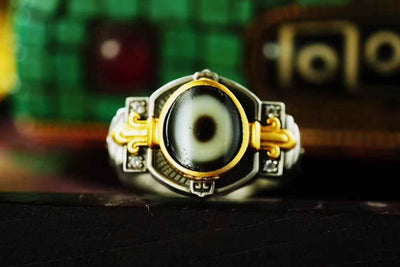
Tibetan silver works well as a daily wear material precisely because it does not demand attention. A silver cuff, a pendant on a cord, a ring with a carved face — these pieces integrate into everyday dressing without effort, adding depth rather than drama.
Best for: Those who prefer substance over shine. Everyday wear with meaning. People drawn to aged textures and symbolic design.
Our silver pieces are made by Tsering, a silversmith from Nagqu who has worked metal since he was fifteen. A Portrait of Tsering →
Shop Tibetan Silver → · Read the Full Guide →
Sacred Wood: Grounding, Natural, Unhurried
If Tibetan silver speaks in the language of symbols, Sacred Wood speaks in the language of touch.
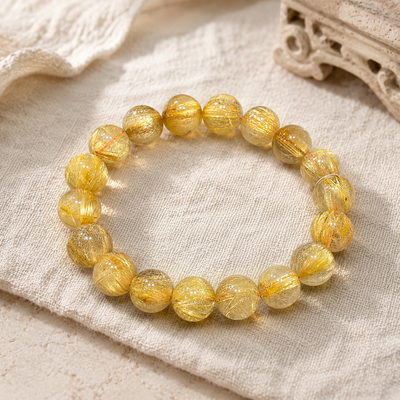
Pick up a bracelet of agarwood beads. Notice the weight — lighter than metal, warmer than stone. Roll one bead slowly between your fingers. The grain is visible, individual, nothing like the next bead. The surface is matte and slightly porous, the way natural things are.
This is what Sacred Wood jewelry offers: a tactile experience that pulls you back into your body. It does not glitter. It does not demand. It simply grounds.
The woods used in Tibetan craft — agarwood, sandalwood, rosewood, bodhi seed — each carry their own character. Agarwood is prized for its rarity and its deep, resinous grain. Sandalwood is pale and clean, associated with calm and clarity. Bodhi seed, the seed of the tree under which the Buddha is said to have reached enlightenment, is one of the most traditional materials for prayer beads and malas.
Sacred Wood is the line for people who meditate, who move slowly through their mornings, who prefer texture over gloss. It is also among the most naturally giftable of all our materials — warm, grounded, and meaningful without being heavy.
Best for: Meditation and mindfulness practice. Those who prefer natural materials. Understated everyday wear. Thoughtful gifts.
Shop Sacred Wood → · Read the Full Guide → · About Bodhi Seed Malas →
Hand-Woven Jewelry: Soft, Personal, Made by Hand
There is something about a hand-knotted bracelet that metal and stone cannot replicate: the evidence of time.
Each knot in a woven Tibetan bracelet was tied by a pair of hands. Each pass of cord through loop was a deliberate act. You cannot automate this. You cannot speed it up without losing it. The value of hand-woven jewelry is inseparable from the labor it contains.
Hand-woven pieces are the lightest and softest of the three Tibetan Craft lines. They sit gently on the wrist. They flex with movement rather than resisting it. They layer easily with other pieces without adding bulk.
The colors and knot patterns used in Tibetan weaving carry their own symbolism — red for protection, gold for prosperity, blue for wisdom. A woven cord may incorporate small metal charms, stone beads, or hand-stamped silver elements, creating a piece that bridges all three craft traditions.
Hand-woven jewelry is often the easiest entry point into Tibetan Craft, and it is consistently among the most meaningful gifts we make. Lightweight enough to forget you are wearing it. Present enough to notice when you are.
Best for: Everyday wear and gifting. Those new to Tibetan jewelry. Layering with silver or wood pieces. Those who value handmade over mass-produced.
Shop Hand-Woven → · Read the Full Guide →
How to Choose Between the Three
The three lines are distinct, but they are not mutually exclusive. Many of our customers wear pieces from all three.
That said, if you are choosing for the first time, here is a simple way to think about it:
- Choose Tibetan Silver if you are drawn to symbols and meaning, prefer aged textures over shine, and want something that will hold its character for years.
- Choose Sacred Wood if you meditate or practice mindfulness, prefer natural materials, or want something that grounds you physically as well as spiritually.
- Choose Hand-Woven if you want something light and personal, are looking for a gift, or want a piece that layers easily with what you already wear.
If you want all three at once — we have written a guide to layering them: Silver, Wood, and Weaving: How to Layer Tibetan Craft for Everyday Wear.
Where to Begin
Tibetan Craft is not a collection to rush through. Each piece has a history, a material logic, a reason for being the way it is.
Start with what draws you. Trust the texture that feels right in your hand. Follow the symbol that stays with you.
Below are the three collections, and our Best Sellers for those who want to start with what others have already found meaningful.
- Tibetan Silver → Full Guide
- Sacred Wood → Full Guide Bodhi Mala Guide
- Hand-Woven → Full Guide
- Best Sellers →
Frequently Asked Questions
What is the difference between Tibetan Silver, Sacred Wood, and Hand-Woven jewelry?
Can I wear pieces from different lines together?
Which Tibetan Craft line is best for someone buying their first piece?
Is Tibetan Craft jewelry suitable as a gift for someone who does not practice Buddhism?
Want to wear all three together? Read the mixing guide: Silver, Wood, and Weaving: How to Layer Tibetan Craft for Everyday Wear →


New to copper and brass? See Tibetan Copper & Brass: Oxidation, Craft, and Care.