Using mala beads for meditation is straightforward once you understand the basic mechanics. The beads give your hands something to do, which frees the mind to focus on the practice rather than on counting. That is the entire point of the object.
This guide covers how to hold a mala, how to count, what to count, and what to do when you reach the guru bead. It assumes no prior experience with mala practice.
→ Part of How to Use Mala Beads: Counting, Meditation, and Daily Practice →
What You Are Doing When You Use a Mala
Mala practice is a form of repetitive meditation — you repeat the same mantra, phrase, or breath count over and over while moving through the beads. The repetition is the practice. Each bead marks one repetition, so by the time you complete a full round of 108 beads, you have done 108 repetitions.
The mala does the counting for you. Your attention stays on the practice — the sound of the mantra, the sensation of the breath, whatever you are working with — rather than on keeping track of numbers.
How to Hold the Mala
Hold the mala in your right hand, draped over the middle finger. Rest it between the middle finger and the thumb. The index finger points away from the beads and does not touch them — in many Tibetan and Hindu traditions, the index finger is associated with the ego and is kept out of contact with the mala during practice.
Begin at the bead just after the guru bead. Use your thumb to pull each bead toward you, one at a time, as you complete each repetition. The motion is gentle — you are rolling the bead toward you, not gripping or pinching.
If this feels awkward at first, that is normal. Most people need three or four sessions before it becomes automatic.
What to Count
What you count depends on your practice and tradition. The most common options:
A mantra — a word or short phrase repeated silently or aloud. "Om mani padme hum" is the most widely used in Tibetan practice. Any phrase that is meaningful to you works. The key is that it is the same phrase every repetition.
The breath — one bead per breath. Inhale, exhale, move the bead. This is a clean entry point for people without a mantra practice. It combines breathwork with the tactile structure of the mala.
An intention or affirmation — a short phrase that represents something you are working toward. This is less traditional but widely used. The repetition functions as a form of deliberate reinforcement rather than devotional practice.
There is no universally correct answer. If you are working with a teacher, they will have specific guidance. If you are practicing independently, start with the breath and shift to a mantra or phrase once the counting mechanics feel natural.
What to Do at the Guru Bead
The guru bead is the large bead at the end of the mala where the tassel or knot is attached. When your thumb reaches the guru bead, you have completed one full round of 108.
Do not count the guru bead as a repetition and do not pass over it. Instead, pause briefly — some practitioners bow their head slightly at this point — and then reverse direction. Turn the mala around and begin moving back through the beads in the opposite direction toward the guru bead again.
This reverse at the guru bead is consistent across traditions. The practical effect is that you never cross over the guru bead, which marks the boundary of the practice.
Using a Mala Bracelet Instead of a Full Mala
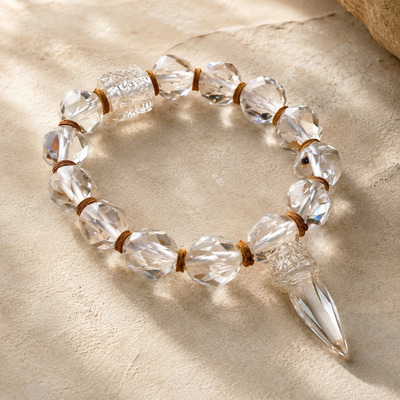
If you are using a 27-bead mala bracelet, one pass through all the beads gives you 27 repetitions. To complete 108, you pass through the bracelet four times. Some people use a finger on the other hand to count passes; others count mentally. Both work.
The mechanics of counting — middle finger, thumb pulling beads, no index finger — stay the same regardless of whether you are using a full mala or a bracelet.
→ Mala Bracelet vs Full Mala: Which One Is Right for You? →
Starting a Practice: A Simple First Session
Sit in a comfortable position. Take three slow breaths to settle. Hold the mala in your right hand, starting just after the guru bead.
For each bead, complete one breath — inhale fully, exhale fully — and pull the bead toward you with your thumb. Move through all 108 beads. When you reach the guru bead, pause, reverse, and begin again if you are continuing.
That is it. The first session does not need to be longer than five to ten minutes. The goal is to get comfortable with the physical mechanics. The practice develops from there.