Mala beads are a counting tool. That is their primary function. Everything else — the material, the symbolism, the ritual associations — builds on that basic utility. You count repetitions of a mantra, a breath, or an intention, and the beads keep track so your attention does not have to.
This hub covers how mala practice works, what forms it takes, and how to decide between a full mala and a bracelet based on how you actually plan to use it.
→ Part of Mala Beads: Types, Meaning, and How to Use Them →
The Basic Mechanics
Hold the mala in the right hand, draped over the middle finger. Use the thumb to pull each bead toward you as you complete one repetition — one mantra, one breath, one count. The index finger stays out of contact with the beads. When you reach the guru bead (the larger bead at one end), do not cross over it. Reverse direction and begin again.
One pass through a 108-bead mala equals 108 repetitions. Many practitioners do multiple rounds in a single session — 108, 216, 324 — the mala handling the count silently while the mind stays with the practice.
→ Full step-by-step guide: How to Use Mala Beads for Meditation →
What to Count
The three most common options:
A mantra — a word or phrase repeated once per bead, silently or aloud. "Om mani padme hum" is the most widely used in Tibetan practice. Any phrase that holds meaning for you works, as long as you use the same one every repetition.
The breath — one bead per complete breath cycle. Straightforward and effective as a starting point for people without an existing mantra practice.
An intention or affirmation — a short phrase representing something you are working toward. Less traditional but widely used, particularly outside of formal religious contexts.
Mala Bracelet vs Full Mala
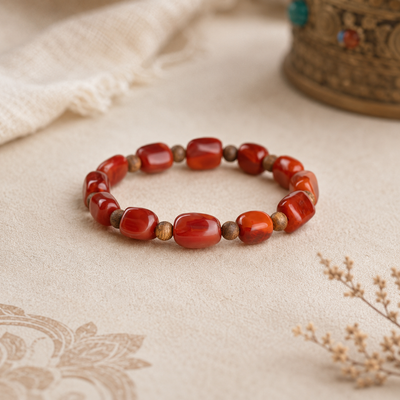
A 27-bead mala bracelet wraps around the wrist and stays there throughout the day. One pass gives 27 repetitions; four passes equals 108. It suits people who want a daily practice object they can use informally — a few rounds during a morning routine, a moment of counting during a stressful afternoon.
A full 108-bead mala is a dedicated practice tool, typically used during sitting sessions rather than worn all day. It suits people with an established sitting practice who want something designed for longer, more formal use.
For most people starting out: the bracelet is the easier entry point.
→ Mala Bracelet vs Full Mala: Which One Is Right for You? →
Caring for Your Mala
Wood malas (bodhi seed, sandalwood) are sensitive to prolonged moisture and benefit from occasional light oiling in dry conditions. Crystal malas handle moisture better but can fade with extended sun exposure. Both types should be stored away from hard surfaces where beads can chip or knock around.
The cord wears before the beads do — check it periodically for fraying and restring before it breaks.
→ How to Cleanse and Care for Your Mala Beads →
 Shop
Shop
 Shop
Shop
 Shop
Shop
 Shop
Shop
 Shop
Shop
 Shop
Shop