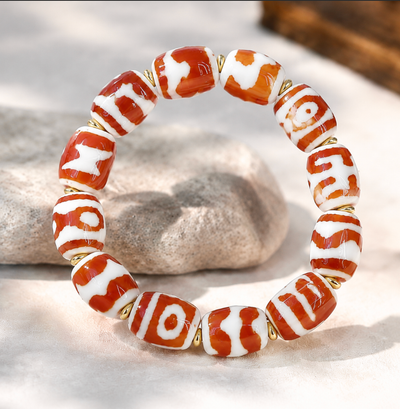
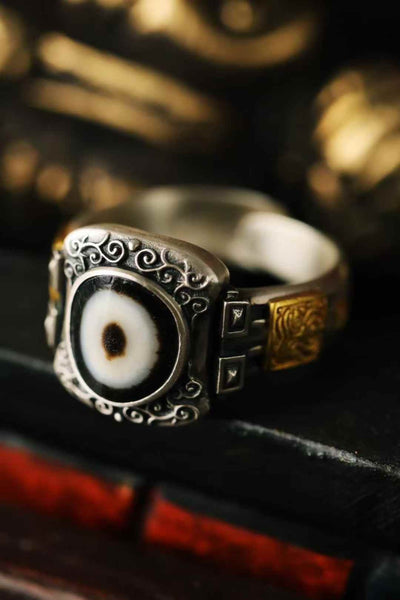
A hand-woven Tibetan bracelet is never just a bracelet. The person who made it made a series of decisions — which thread, which knot, which color against which — and each of those decisions often follows associations rooted in Tibetan and Himalayan craft traditions, though specific meanings vary by region and maker. Understanding those associations makes you a more conscious wearer of what you have on your wrist.
This is a guide to reading the language of Tibetan hand-woven jewelry — the knots, the colors, the patterns — without requiring any background in Buddhism or Himalayan history to follow along.
The Knot: More Than a Closure
Knot associations vary across Tibetan traditions — the readings below reflect common interpretations, not a single canonical system.
In Tibetan craft tradition, the knot functions as a symbol in its own right, not only as a closure. The act of knotting is understood as an act of intention: you close a loop, you hold something in place, you bind a meaning to a material. This is why many Tibetan bracelets are made with a specific number of knots, or why the central knot of a design is often given more complexity than the surrounding ones.
The endless knot (Shrivatsa) is among the most recognizable motifs in Tibetan Buddhism and appears frequently in woven work. It is often interpreted as representing the interdependence of all things: how causes and effects, wisdom and compassion, are woven together without a visible beginning or end. On a bracelet, it functions as a continuous reminder of connection.
The sliding knot closure used in many Tibetan bracelets also carries intention. The two cords that cross and tighten are sometimes interpreted as a representation of balance — two forces that hold the center steady.
Multiple knots in sequence are sometimes used as a counting structure — a simplified mala, where the bracelet serves as a portable counting tool during mantra practice. A bracelet with 21 knots can anchor a complete round of a short mantra without requiring a full 108-bead mala.
Color: A Vocabulary That Predates Words
Color associations in Tibetan weaving vary by lineage and region. The notes below are a simplified guide for shoppers — useful for choosing with intention, not a comprehensive account of any single tradition.
In many Tibetan contexts, color symbolism is tied to the five Buddha families and the five elements — earth, water, fire, wind, and space. These associations run through Tibetan visual culture, including jewelry.
White — commonly associated with clarity, purity, and the water element in many Tibetan weaving contexts. White thread is frequently used in blessing cords.
Red — commonly associated with energy and protection in many Tibetan craft contexts. Red cord appears frequently in amulet bracelets made for health and strength.
Yellow / Gold — often associated with abundance and the earth element in many Tibetan traditions. Gold-toned weaving frequently appears in pieces made for prosperity.
Blue / Black — often associated with stability and protection in many Tibetan contexts. Darker cords are commonly used in pieces intended to ground or shield. The specific reading varies by lineage.
Green — commonly associated with healing and balance in many Tibetan weaving traditions. Green-threaded pieces often appear in wellness contexts.
Multi-color pieces are often constructed to carry multiple intentions simultaneously, or to represent the completeness of all five elements together. The Thunderbird Turquoise Necklace is a good example: the turquoise carries its own symbolic weight in Tibetan tradition, and the overall color palette is a considered whole.

Pattern: How Structure Becomes Symbol
The pattern in a woven bracelet is the result of how individual threads cross over and under one another in sequence. In Tibetan textile tradition, this sequence is not arbitrary — specific crossing patterns are associated with specific outcomes and used in specific ritual contexts.
Diamond patterns appear frequently in Tibetan weaving and are associated with protection — the four points of the diamond representing the four directions, the center representing the axis of the self.
Wave or flowing patterns are associated with continuity and flow — life moving forward without obstruction. These appear in pieces given for journeys, transitions, and new beginnings.
Tight, dense patterns — where threads are closely packed with minimal visible gaps — are associated with strength and containment. Loose, open patterns carry the opposite energy: spaciousness, breath, ease.
When you look at the Snowland Blessing Weave Bracelet, you are reading a pattern language that Tibetan weavers have refined over generations — the colors chosen for their elemental correspondence, the knot structure chosen for its protective resonance.

Reading Your Own Piece
You do not need to know the name of every pattern to engage with what a woven piece is doing. Start with color — what does the palette feel like? Warm or cool? Grounding or uplifting? Then look at the knots — are they tight and deliberate, or loose and flowing? Then the overall pattern — does it repeat evenly, or does it build toward a center?
These observations will not produce a technically precise reading of the symbolism. But they will give you a relationship with the piece that goes beyond surface appearance — which is, ultimately, what Tibetan craft jewelry is for.
Looking for a hand-woven piece to give as a gift? The Best Hand-Woven Tibetan Bracelets as Gifts →
Both, and the two are not separate in the Tibetan tradition. The color palette of a well-made Tibetan woven piece is not chosen to match a trend. In many pieces, color choice reflects both aesthetic judgment and symbolic association — the maker was thinking about both at once. A bracelet that looks harmonious often carries a coherent symbolic message.
In most traditional Tibetan woven work, the central element represents the axis point: the self, the center of intention, the place from which the weaving radiates outward. It is structurally and symbolically the anchor of the piece. This is why the central element is often given more complexity than the surrounding pattern.
Yes, over time and with regular wear. Natural dyes fade gradually into softer, earthier versions of their original tone — many wearers find the result more beautiful than the original. Fading is not a sign of poor quality; it is a sign the bracelet has been worn. If you want to preserve the original palette, avoid leaving the bracelet in direct sunlight for extended periods.