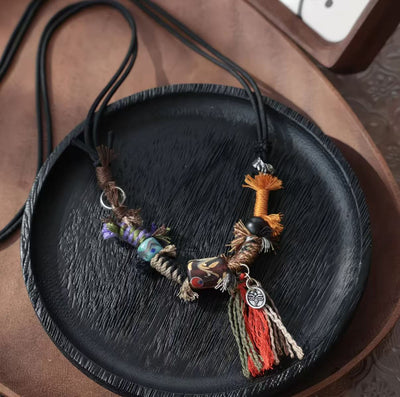
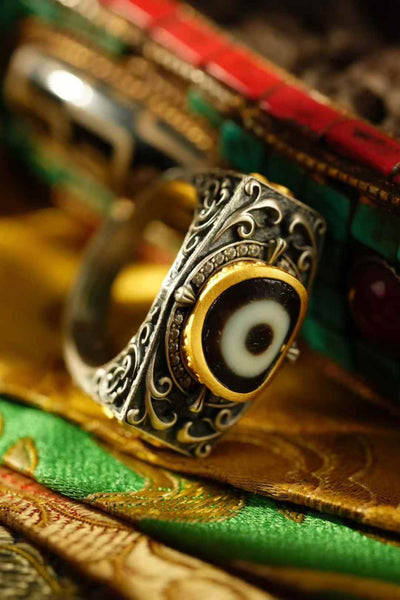
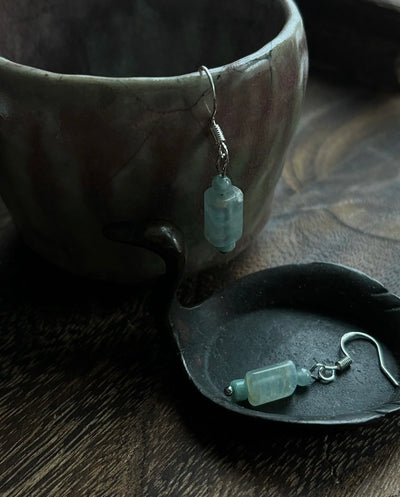
"Tibetan stone" is not a gemological classification. You will not find it in a mineralogy textbook. It is a craft and cultural designation — a way of describing natural stones that appear in Tibetan and Himalayan jewelry traditions, chosen for their color, cultural meaning, and material character rather than their place in a geological taxonomy.
Understanding this changes how you shop for Tibetan stone jewelry. You are not buying by lab-certified grade or standardized purity. You are buying into a material tradition with its own priorities.
What the Term Actually Covers
At TibetanSerenity, Tibetan Stones refers to three primary materials: turquoise, nanhong, and agate. Each has a distinct visual identity and a distinct role in the Tibetan craft tradition.
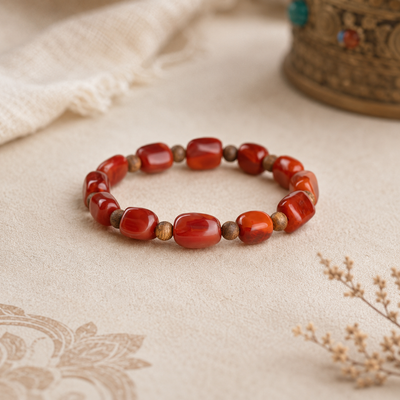
Turquoise — blue-green, often with darker matrix lines running through it — is one of the most historically significant stones in Tibetan adornment. Nanhong is a deep red agate variety from Yunnan province, valued for its color depth and relative rarity in Western markets. Agate is the broadest category: banded, variable in color, and used across multiple traditions for centuries.
What connects them is not a shared mineral identity — turquoise is a phosphate mineral, nanhong and agate are both forms of chalcedony — but a shared aesthetic and cultural context. They are stones that have been worn in the Himalayan region for generations, and they carry that history in their appearance even when you cannot articulate exactly what it is.
How Tibetan Stone Jewelry Differs from Conventional Gemstone Jewelry
In most fine jewelry markets, stones are graded by clarity, cut, and color uniformity. A high-quality stone in this system is one that looks like the next stone in the batch. Tibetan stone jewelry works from a different premise entirely.
Natural variation is expected and valued. The matrix lines in turquoise — the dark veins running through the blue-green surface — are not imperfections. They are evidence of how the stone formed. The slight color variation between two nanhong beads on the same bracelet is not a quality control failure. It is the natural result of working with a real stone rather than a synthetic uniform material.
This means no two Tibetan stone pieces are exactly alike. If you are buying for uniform appearance, this is not the right category. If you are buying for natural character and material honesty, it is exactly the right one.
Who Tibetan Stone Jewelry Suits
The people who tend to wear Tibetan stone jewelry regularly share a few characteristics. They prefer matte and earthy finishes over bright and polished ones. They are drawn to objects that look like they came from somewhere rather than objects that look like they were manufactured to specification. They want jewelry that has visual presence without being decorative in the conventional sense.
It also suits people who want their jewelry to mean something specific. Tibetan stone pieces are not chosen at random — turquoise for protection and travel, certain agates for grounding, nanhong for warmth and vitality. The meaning is not required to make the piece work, but it is available if you want it.

What to Look for When Buying
Three practical questions to ask before buying a Tibetan stone piece:
Is the stone natural? Dyed or synthetic stones are common in the lower end of the market. Natural stones have variation; synthetic stones look too uniform. For turquoise specifically, ask whether it is natural, stabilized, or reconstituted — these are meaningfully different products at meaningfully different price points.
Does the color and texture appeal to you directly? Tibetan stone jewelry is visually distinctive. If you respond to the color and texture of a piece before you know anything about its meaning, that is usually a reliable signal. If you are buying primarily because you like the idea of what it represents but the visual does not appeal to you, the piece will probably sit unworn.
Does the setting suit how you plan to wear it? Some Tibetan stone pieces are substantial and work best as statement pieces. Others are low-profile enough for daily wear without thinking about them. Decide which category you need before choosing the specific stone.
Turquoise in Tibetan Jewelry: Meaning, Symbolism, and How to Choose →
What Is Nanhong? Color, Meaning, and Why Collectors Love It →
Agate in Tibetan Jewelry: Meaning, Texture, and Everyday Wear →