If you have looked at a piece of Tibetan silver jewelry and thought — this doesn't look like regular silver — you are right. It isn't.
Tibetan silver has a different finish, a different texture, and a different set of priorities from the silver jewelry you find in most mainstream stores. Understanding those differences makes it easier to know what you are buying, whether it is right for you, and what to expect as you wear it over time.
What Tibetan Silver Actually Is
The term "Tibetan silver" does not refer to a specific metal purity the way "sterling silver" does. Sterling silver is a precise alloy — 92.5% pure silver, 7.5% other metals, usually copper. It is a standard with legal definitions in most countries.
Tibetan silver, by contrast, is a style and craft tradition. It describes jewelry made in the aesthetic and technique of Tibetan metalwork — characterized by oxidized or darkened finishes, hand-hammered textures, engraved or cast symbolic motifs, and an overall quality of age and handwork. The metal content varies: some Tibetan pieces are made from sterling silver, others use silver-colored alloys that may include white metal, zinc, or other materials.
What this means in practice: when you buy Tibetan silver jewelry, you are buying primarily for the aesthetic, the symbolism, and the craft — not for precious metal content. If metal purity is your primary concern, ask the maker directly. If what draws you is the look, the meaning, and the texture, Tibetan silver delivers something that sterling silver, for all its purity, often does not.
The Finish: Why It Looks the Way It Does
The most immediately distinctive quality of Tibetan silver is its surface. Where conventional fine silver jewelry is polished to a bright, reflective finish, Tibetan silver is typically matte, aged, or oxidized.
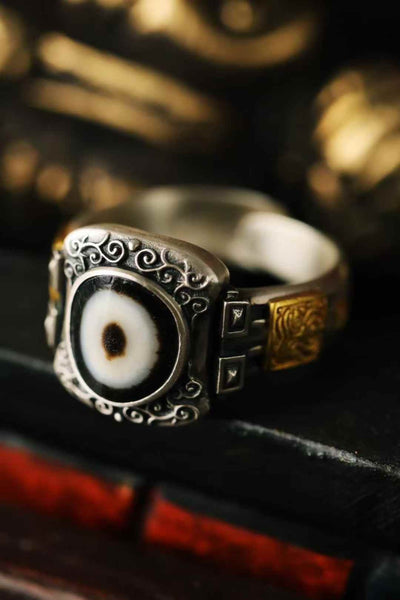
This finish is achieved through deliberate treatment. Silversmiths use liver of sulfur or similar oxidizing agents to darken the metal, then selectively buff raised areas to create contrast — dark in the recesses, lighter on the high points. The result is a surface that reads as three-dimensional, where engraved symbols and textures become dramatically more visible than they would be on a bright-polished surface.
Hand-hammering adds another layer of texture. The small facets left by hammer work catch light at multiple angles simultaneously, creating a warmth and depth that uniform machine finishing cannot replicate. No two hammer-finished pieces look exactly alike.
Over time, Tibetan silver continues to develop. The oxidized finish deepens with exposure to air and skin. Raised areas that contact skin and fabric gradually develop a subtle burnish from friction. The piece slowly becomes more itself — more clearly the product of its material, its making, and its use.
Tibetan Silver vs Sterling Silver: The Practical Differences
Both materials can make excellent jewelry. The right choice depends on what you are looking for.
Appearance: Sterling silver in its standard polished form is bright and mirror-like. Tibetan silver is matte, aged, and textured. If you want jewelry that reads as bright and modern, sterling is the natural choice. If you want something that reads as grounded, ancient, and handmade, Tibetan silver delivers that quality in a way polished sterling cannot.
Aging: Both materials tarnish over time. Sterling silver tarnishes to a yellowish-gray that most wearers treat as something to clean away. Tibetan silver, already aged at the surface, continues to deepen in a way that most wearers experience as the piece improving rather than degrading.
Symbolism: Sterling silver jewelry is often plain or set with stones. Tibetan silver is almost always symbolic — the surface carries meaning through its engraved or cast motifs. If you want jewelry that says something beyond its material, Tibetan silver is the more expressive choice.
Price: Because Tibetan silver value lies primarily in craft rather than metal purity, well-made Tibetan pieces can be significantly more accessible than sterling jewelry of equivalent visual complexity.
Who Tibetan Silver Is For
Tibetan silver suits people who are drawn to objects with history — or the feeling of history. It suits those who prefer their jewelry to look worn-in rather than brand-new, who value meaning over mirror-brightness, who want something that deepens rather than fades.
It works particularly well for everyday wear. A matte, oxidized surface is more forgiving of small scratches and daily contact than a polished one. The aesthetic actually benefits from use in a way that requires no maintenance beyond occasionally wiping with a soft cloth.
It is also, consistently, jewelry that people keep for a long time. Not because it is precious in the conventional sense, but because it develops a relationship with the person wearing it — becoming more individual, more personal, more theirs with each passing year.
Browse our Tibetan Silver collection — bracelets, pendants, rings, and more.
← Back to What Is Tibetan Silver? — Meaning, Craft & How to Choose · Tibetan Craft Overview
Frequently Asked Questions
How can I tell if a Tibetan silver piece is well made?
Will Tibetan silver turn my skin green?
Can I clean Tibetan silver the same way I clean regular silver?
Is Tibetan silver safe for people with metal allergies?
Want to mix Tibetan silver with wood or woven pieces? Silver, Wood, and Weaving: How to Layer Tibetan Craft for Everyday Wear →